
Key takeaways
- Since 31 January 2025, you no longer have to own a flat for two years before extending the lease or buying the freehold.
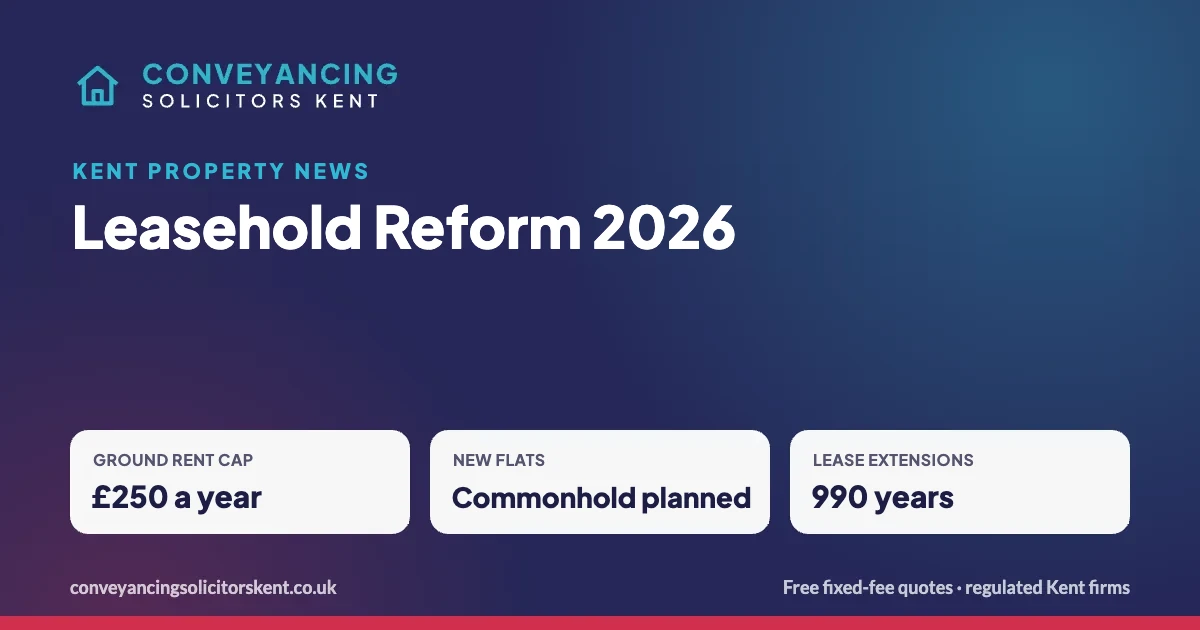
- A cap on existing ground rents of £250 a year is proposed, likely from late 2028 if Parliament approves it.
- The government plans to make commonhold the default for new flats through the Commonhold and Leasehold Reform Bill.
- Cheaper lease extensions, with no marriage value and a 990-year term, are law but not yet in force, and freeholders are appealing.
- For now you buy and sell on today’s rules, so your solicitor checks the lease, ground rent and service charges as usual.
What has already changed?
The Leasehold and Freehold Reform Act 2024 became law on 24 May 2024, but most of it needs further regulations before it takes effect. Two changes are already in force:
- No two-year wait. Since 31 January 2025, you can extend your lease or buy your freehold as soon as you buy the flat.
- Easier right to manage. Since 3 March 2025, more buildings qualify for leaseholders to take over management, and they no longer have to pay the freeholder’s legal costs.
Separately, the Leasehold Reform (Ground Rent) Act 2022 already ended ground rents on most new residential leases.
A £250 cap on ground rents
The government plans to cap ground rents on existing leases at £250 a year, falling to a nominal “peppercorn” after 40 years. The cap is part of the Commonhold and Leasehold Reform Bill and is likely to take effect in late 2028, subject to Parliament. A committee of MPs has urged the government to bring it in a year earlier.
This matters most for flats and houses with high or rising ground rents, such as rents that double every 10 or 25 years. Until the cap is in force, those terms still affect what lenders will offer and how easy a home is to sell.
Cheaper lease extensions are not here yet
The 2024 Act changes how the cost of a lease extension or freehold purchase is worked out. It removes marriage value, which can add thousands to the cost once a lease drops below 80 years, and raises the standard extension to 990 years at a peppercorn ground rent.
These rules are not in force yet. The government plans to fix technical problems in the Act through the new Bill, and it consulted on the rates used in the calculation until 23 September 2026. Freeholder groups challenged the changes. The High Court dismissed their claims in October 2025, but the Court of Appeal has allowed five of them to appeal.
If your lease is getting short, whether to extend now or wait depends on how many years are left. The government-funded Leasehold Advisory Service (LEASE) has free guidance.
Commonhold for new flats
A draft Commonhold and Leasehold Reform Bill was published on 27 January 2026 and the Bill was announced in the King’s Speech. It would make commonhold the default for new flats, so owners own their flat outright and run the building together, with no landlord or ground rent. It would also replace forfeiture, the landlord’s power to end a lease for breaches.
MPs have recommended that the final Bill is introduced this autumn. Until it passes and comes into force, new flats will still be sold leasehold. The 2024 Act will also ban most new leasehold houses once the rule is brought in.
Service charges and building insurance
In July 2026 the government confirmed plans for standard service charge demand forms, an annual report for leaseholders, stronger rights to ask for information, and limits on the commissions landlords and agents can take on building insurance. The regulations are due in 2026, with the changes taking effect from 2027.
When will the changes happen?
| When | What changes |
|---|---|
| Already in force | No two-year wait to extend or buy the freehold (January 2025); easier right to manage (March 2025); no ground rent on most new leases (2022) |
| From 2027 | Clearer service charge demands, annual reports and limits on insurance commissions |
| Once the new Bill passes | Commonhold the default for new flats; fixes needed to start cheaper lease extensions |
| Late 2028 (proposed) | £250 ground rent cap on existing leases |
What it means if you are buying or selling in Kent
Kent has a lot of leasehold homes: seafront and converted flats in Margate, Folkestone and Herne Bay, flats in converted villas in Tunbridge Wells, town-centre flats in Maidstone, and retirement flats along the coast in places like Birchington.
- Buyers: check the years left on the lease, the ground rent and how it rises, the service charge and any planned major works. For retirement flats, ask about event fees when you sell.
- Sellers: ask your managing agent for the management pack as soon as you list, as it often takes weeks. If the lease is short, ask your solicitor whether to start an extension before you sell.
- Everyone: do not delay a move waiting for reforms that are years away. Your solicitor can explain how the planned changes might affect your flat.
Our leasehold conveyancing guide explains what your solicitor checks and what it costs.
FAQs
Leasehold reform 2026: FAQs
Has the £250 ground rent cap started?
No. It is proposed in the Commonhold and Leasehold Reform Bill and is likely to apply from late 2028 at the earliest, if Parliament approves it.
Should I wait to extend my lease?
It depends on how many years are left and the ground rent. Once a lease is near or below 80 years the cost can rise quickly, so get advice early. LEASE has free guidance on extending now or waiting.
Can I still buy a leasehold flat in Kent?
Yes. Leasehold flats are bought and sold every day. Your solicitor checks the lease length, ground rent, service charges and any restrictions before you exchange.
Will new flats still be sold leasehold?
For now, yes. The government plans to make commonhold the default for new flats, but that needs the new Bill to pass and come into force.
Related
Related guides
Official sources on leasehold reform: Leasehold reform in England: what’s happening and when? (House of Commons Library) · Leasehold Advisory Service (LEASE) · Leasehold property (GOV.UK)
Ready when you are
Moving home in Kent? Get your quote today.
Free, fixed fees and no obligation.